

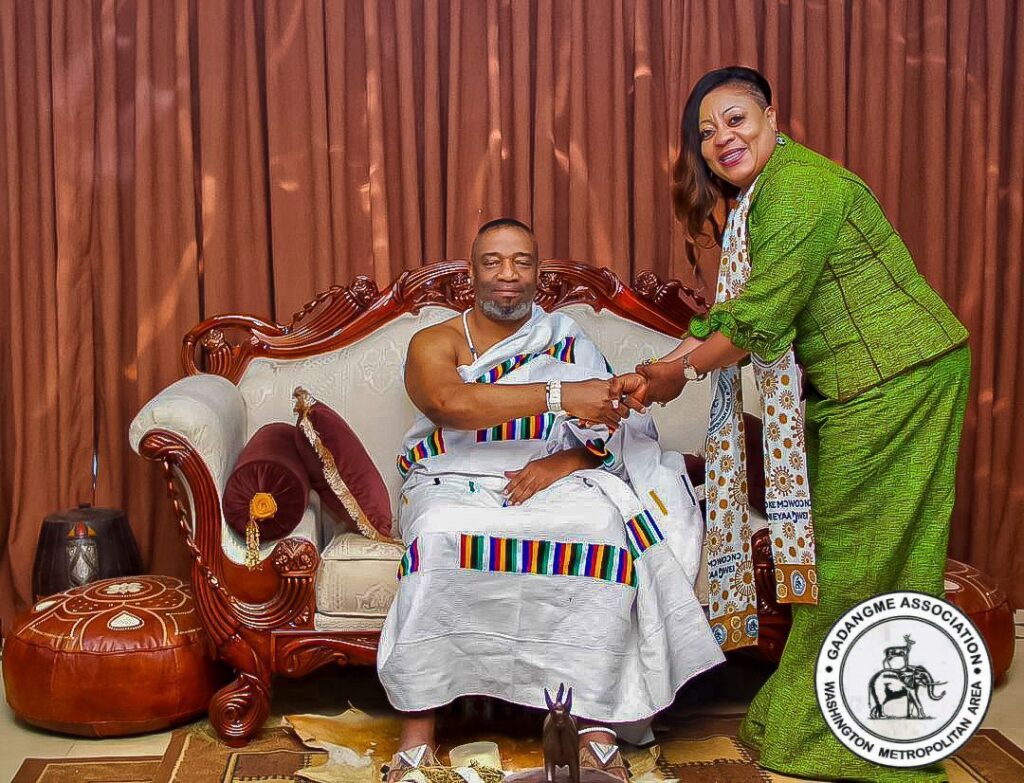
The GaDangme Association of Washington Metropolitan Area, on Wednesday, March 25, 2026, donated a cash amount of Two Thousand Dollars ($2,000) to sponsor the 2026 edition of the Inter-Schools Ga Culture Quiz Competition. The presentation took place at the residence of His Royal Majesty Nii Tackie Teiko Tsuru II. The Association recognizes cultural heritage as the heartbeat of every society, the living memory that binds generations together and provides identity, dignity, and purpose for a people. Across the world, communities that intentionally protect and promote their cultural traditions are those that remain resilient in the face of globalization, technological transformation, and social change.
The Chairwoman of the GaDangme Association of Washington Metropolitan Area, Rowina Naa Odarkai Lamptey Moses, presented the $2,000 cash donation to the Adabraka Mantse, Nii Tetteh Adjabeng II. The occasion was attended by members of the Association, Kokomlemle Mantse Nii Tettey Obroni Onam Onsro II and also members of the Quiz Planning Committee. Participating schools and contesting learners will be presented with Ga dictionaries and Ga textbooks as appearance awards at the preliminary stages. It is expected that, by the end of this important program, the learners will be well equipped to perform creditably in the BECE examination in the Ga language.
When the GaDangme Association of Washington Metropolitan Area was founded four decades ago, its visionary founders were driven by a simple yet powerful dream, to create a home away from home for GaDangme people living in the diaspora. They envisioned an organization that would preserve the values, traditions, and languages of the Ga and Dangme ethnic groups, ensuring that these cultural treasures would not fade abroad. However, they also recognized that building such a community would require more than passion, it would demand partnerships, alliances, and a network of supporters who shared their vision.
The Inter-Schools Ga Culture Quiz Competition is a flagship literacy initiative championed by HRM Nii Tackie Teiko Tsuru II, and the Adabraka Mantse, Nii Tetteh Adjabeng II, in collaboration with key stakeholders in educational tourism. Two hundred and forty (240) or more selected junior high schools from private, public, and faith-based institutions offering the Ga language will compete from the preliminary stages. Four (4) top schools will qualify to represent their municipality and compete with schools from other municipalities from the quarterfinals through to the grand finale.
This quiz initiative is vital and dedicated to preserving and promoting the Ga language, improving local tourism, and strengthening cultural values. It is within this context that the GaDangme Association of Washington Metropolitan Area is partnering with the Quiz organizers to demonstrate remarkable leadership in cultural preservation, education, and youth empowerment. Through visionary initiatives and sustained community engagement, the Association has created platforms that allow young GaDangme descendants in the diaspora to learn about their history, language, customs, and traditions in meaningful and engaging ways. One of the most outstanding of these initiatives is the Inter-Schools Ga Culture Quiz Competition, which the Association is proudly sponsoring, an educational and cultural program designed to inspire students to explore the richness of GaDangme heritage while developing intellectual curiosity, academic excellence, and cultural pride.
Culture is more than language, music, clothing, or festivals; it is the foundation of a people’s worldview, their philosophy of life, their values, and the wisdom passed down through generations. When culture is preserved, history remains alive, identity remains strong, and the younger generation inherits a sense of belonging that strengthens the future of the entire society. For the GaDangme people of Ghana, culture is a powerful symbol of unity, resilience, pride, and historical continuity. The Ga and Dangme ethnic groups, primarily located in the Greater Accra Region and parts of the Eastern Region of Ghana, possess one of the richest cultural traditions in West Africa. Their history is deeply rooted in centuries of migration, settlement, trade, governance, spirituality, and community leadership. The GaDangme language, customs, chieftaincy systems, festivals, traditional knowledge, and social values form an important pillar of Ghana’s national cultural heritage. However, as modern societies evolve and younger generations grow up in increasingly globalized environments, preserving indigenous culture requires deliberate action, structured education, and sustained community engagement. This responsibility becomes even more significant for the GaDangme Association of Washington Metropolitan Area, whose members live far from their ancestral homeland.
Across the globe, millions of GaDangme people reside outside the continent, pursuing education, professional careers, and business opportunities in various countries. While these diaspora communities contribute significantly to their home country through remittances, investment, and cultural diplomacy, they also face the challenge of ensuring that their children remain connected to their heritage. Many young people born or raised abroad may grow up speaking foreign languages, attending international schools, and interacting with diverse cultures, sometimes at the expense of fully understanding the traditions and identity of their ancestral roots. For leaders of the GaDangme Association of Washington Metropolitan Area, preserving this cultural connection has become a mission of great importance.
The 2026 edition of the Inter-Schools Ga Culture Quiz Competition, proudly co-sponsored by the GaDangme Association of Washington Metropolitan Area, represents a strong commitment to cultural education and the empowerment of the next generation. This initiative goes beyond a simple academic contest; it serves as a dynamic cultural classroom where students learn about GaDangme history, language, traditions, festivals, leadership structures, historical heroes, and societal values. Through rigorous preparation, friendly competition, and public engagement, the quiz competition transforms cultural knowledge into a source of pride and inspiration for young participants.
The program also reflects a deeper philosophy: education and culture must work together to shape well-rounded individuals. When students learn about their cultural heritage alongside their academic studies, they develop a broader understanding of their identity and their place in the world. Cultural education strengthens confidence, nurtures leadership qualities, and fosters respect for diversity. For GaDangme youth living abroad, such knowledge becomes an anchor that connects them to their ancestral homeland, reminding them that they are part of a long and proud historical legacy.
According to the Chairwoman of the GaDangme Association of Washington Metropolitan Area, Rowina Naa Odarkai Lamptey Moses, the sponsorship of the 2026 Ga Culture Quiz Competition demonstrates the Association’s unwavering dedication to preserving the cultural heritage of the GaDangme people for future generations. It also highlights the critical role that the Association plays in sustaining cultural traditions across borders. By investing in cultural education programs that engage young minds, the Association ensures that GaDangme heritage continues to thrive not only in Ghana but also among diaspora communities around the world.
Beyond cultural preservation, the quiz competition serves as a powerful tool for intellectual development and community unity. Students participating in the competition are encouraged to conduct research, read historical texts, engage with elders, learn traditional stories, and explore the meaning behind cultural practices. This process deepens their understanding of the GaDangme worldview while strengthening their academic skills. At the same time, the competition brings together families, educators, cultural leaders, and community members in a shared celebration of knowledge and heritage.
Chairwoman Naa Odarkai Lamptey emphasized that the 2026 edition of the quiz competition promises to be even more impactful as it continues to expand participation, deepen educational content, and inspire a new generation of cultural ambassadors. Through this initiative, the GaDangme Association of Washington Metropolitan Area reinforces the message that culture is not something to be remembered occasionally; it is something to be lived, taught, celebrated, and passed on with pride. As the world becomes increasingly interconnected, the preservation of cultural identity becomes both a responsibility and an opportunity. Programs like the Inter-Schools Ga Culture Quiz Competition serve as powerful guardians of heritage, ensuring that future generations remain rooted in their traditions while confidently engaging with the global community.
The GaDangme Association of Washington Metropolitan Area has long recognized that cultural preservation requires more than nostalgic remembrance of traditions; it demands active education, community participation, and innovative programs that capture the interest and imagination of young people. In an age where digital media, globalization, and multicultural influences shape the worldview of younger generations, cultural organizations must create initiatives that present heritage in ways that are engaging, relevant, and intellectually stimulating. The Inter-Schools Ga Culture Quiz Competition is a powerful example of such an initiative, combining academic challenge with cultural exploration to create an educational experience that strengthens identity and pride among GaDangme youth.
According to the Adabraka Mantse, Nii Tetteh Adjabeng II, the significance of the quiz competition lies in its ability to transform cultural knowledge into an interactive learning experience. Rather than presenting culture as static information confined to textbooks or ceremonial events, the competition encourages students to actively explore and internalize the stories, traditions, and historical milestones that define the GaDangme people. Through carefully structured quiz rounds, participants engage with topics that span language, history, traditional governance systems, festivals, proverbs, folklore, historical migrations, and the contributions of prominent GaDangme leaders throughout history.
This learning process fosters curiosity and encourages students to ask questions about their heritage. Young participants often begin researching their culture more deeply, consulting books, interviewing elders, and engaging with community leaders to expand their understanding. Such interactions create intergenerational dialogue, allowing elders to pass down knowledge that might otherwise be lost over time. The quiz competition therefore becomes more than a contest; it becomes a bridge connecting generations within the GaDangme community.
One of the most remarkable aspects of the initiative is its emphasis on language preservation. Language is one of the most vital carriers of culture, containing proverbs, idioms, expressions, and philosophies that reflect a people’s worldview. For many diaspora families, maintaining fluency in indigenous languages can be challenging, as children grow up speaking English or other dominant languages in their host countries. The quiz competition addresses this challenge by incorporating GaDangme language questions that encourage students to learn vocabulary, understand traditional expressions, and appreciate the linguistic richness of their heritage. As students prepare for the competition, they often begin speaking more GaDangme at home, practicing pronunciation and learning the meanings behind traditional sayings. This process not only strengthens language skills but also deepens cultural understanding, as many GaDangme proverbs carry profound lessons about life, leadership, humility, perseverance, and communal responsibility. Through these linguistic explorations, young participants begin to appreciate the wisdom embedded within their cultural traditions.
The competition also highlights the historical achievements and resilience of the GaDangme people. Students learn about the migration histories that shaped GaDangme settlements, the establishment of traditional kingdoms, and the leadership structures that guided communities through centuries of social and political development. They explore the significance of chieftaincy institutions, traditional governance systems, and the role of elders in maintaining social harmony and cultural continuity.
Understanding these historical foundations instills pride and confidence in young participants. It reminds them that their heritage is rooted in a long history of resilience, leadership, innovation, and community organization. For diaspora youth who may sometimes feel disconnected from their ancestral homeland, such knowledge becomes a powerful affirmation of identity.
Cultural festivals also play a central role in the educational content of the quiz competition. Students learn about the meaning, history, and symbolism behind major GaDangme festivals such as Homowo and Asafotufiam. They explore how these festivals commemorate historical events, celebrate agricultural success, and strengthen community unity. Through this knowledge, participants gain a deeper appreciation for the spiritual and social significance of cultural celebrations that might otherwise appear merely festive or ceremonial.
Rowina Naa Odarkai Lamptey Moses stated that the educational benefits of the competition extend beyond cultural knowledge to include intellectual development and critical thinking. Quiz competitions require students to analyze information, recall facts quickly, and think strategically under pressure. These skills enhance academic performance and prepare students for broader educational challenges. By integrating cultural content with academic competition, the GaDangme Association supports a program that simultaneously promotes cultural pride and academic excellence.
Community engagement is another powerful dimension of the initiative. The quiz competition attracts participation not only from students but also from parents, teachers, community leaders, and cultural organizations. Families often support their children’s preparation by discussing cultural topics at home, attending study sessions, and encouraging active participation. These shared experiences strengthen family bonds and reinforce the importance of cultural education within the community.
Teachers and cultural educators also play a vital role in preparing students for the competition. Many schools and community groups organize study programs, cultural workshops, and practice quizzes that help participants deepen their understanding of GaDangme heritage. Through these collaborative efforts, the quiz competition becomes a community-wide project that unites individuals around a shared commitment to cultural preservation.
The sponsorship of the 2026 edition by the GaDangme Association of Washington Metropolitan Area reflects the Association’s broader vision of empowering youth as cultural ambassadors. By equipping young people with knowledge of their heritage, the Association ensures that future generations will continue to promote and protect GaDangme culture in diverse global environments. These young participants will grow into confident individuals who can proudly represent their heritage in academic, professional, and social settings.
In addition to cultural education, the competition also promotes leadership and teamwork among students. Participants often work in teams representing their schools or community groups, collaborating to study cultural topics and support one another during the competition. This teamwork builds communication skills, mutual respect, and a spirit of healthy competition that encourages excellence.
The impact of such initiatives extends far beyond the competition day itself. Students who participate often develop a lifelong interest in cultural studies, community service, and heritage promotion. Some may pursue academic research in African history, linguistics, anthropology, or cultural studies, contributing to the preservation and documentation of indigenous knowledge systems.
Naa Odarkai Lamptey further stated that, for the GaDangme Association, the quiz competition represents a long-term investment in cultural continuity. Each participating student becomes a potential cultural custodian who will carry forward the traditions, language, and values of the GaDangme people. In this way, the competition serves as a seed planted in the minds of young participants, nurturing a deep-rooted sense of belonging that grows stronger over time.
The 2026 edition promises to build upon the successes of previous competitions by expanding participation, enriching educational content, and strengthening partnerships with schools and cultural institutions. As the event grows in scale and visibility, it has the potential to inspire similar cultural education initiatives within other Ghanaian and African diaspora communities. Through vision, dedication, and community collaboration, the GaDangme Association of Washington Metropolitan Area continues to demonstrate that cultural preservation is not merely about remembering the past; it is about empowering the future. By investing in the education and inspiration of young people, the Association ensures that GaDangme heritage remains vibrant, respected, and celebrated across generations and across continents.
The Inter-Schools Ga Culture Quiz Competition therefore stands as a shining example of how diaspora communities can preserve their heritage while nurturing intellectual excellence and leadership among the youth. In celebrating knowledge, culture, and community, the 2026 edition of the competition will once again affirm the enduring strength and pride of the GaDangme people, ensuring that their rich cultural legacy continues to illuminate the path for generations yet to come.
Over the years, the GaDangme Association of Washington Metropolitan Area has established strong ties with Ghanaian embassies and consulates, local governments, churches, schools, and other diaspora organizations. Each collaboration has contributed to a mosaic of support that has strengthened the Association’s foundation. The Embassy of Ghana in Washington, D.C. has often been a key ally, providing not only diplomatic guidance but also cultural legitimacy to the Association’s initiatives. Churches within the Ghanaian and African communities have opened their doors to offer spiritual support, and encourage members to participate in cultural programs. Local community organizations have partnered with the Association on outreach initiatives, health fairs, educational projects, and social programs designed to uplift both GaDangme people and the broader African diaspora.
These partnerships have enabled the Association to extend its influence beyond cultural preservation to social impact, supporting youth development, empowering women, assisting families, and contributing to community advancement. The Association has expressed deep humility and gratitude to its many partners, supporters, and friends who have stood by it throughout its four-decade journey. Over the years, the Association has become a cultural bridge, linking generations and nations. Its success stories are not isolated but interconnected with those of other Ghanaian associations, African unions, and diaspora networks. Through joint events, collaborative projects, and shared advocacy, the GaDangme Association of Washington Metropolitan Area has played a key role in the broader narrative of African unity in the diaspora. Whether organizing independence celebrations or cultural exhibitions, the Association has consistently thrived on collective action and shared purpose.
HRM Nii Tackie Teiko Tsuru II and his elders, together with the Adabraka Mantse, Nii Tetteh Adjabeng II, Kokomlemle Mantse Nii Tettey Obroni Onam Onsro II and members of the Quiz Planning Committee, expressed their appreciation to the GaDangme Association of Washington Metropolitan Area for its generous support of the 2026 edition of the Inter-Schools Ga Culture Quiz Competition. “Your commitment to our mission is truly inspiring, and we are honored to have you as valued partners,”HRM Nii Tackie Teiko Tsuru II concluded.