

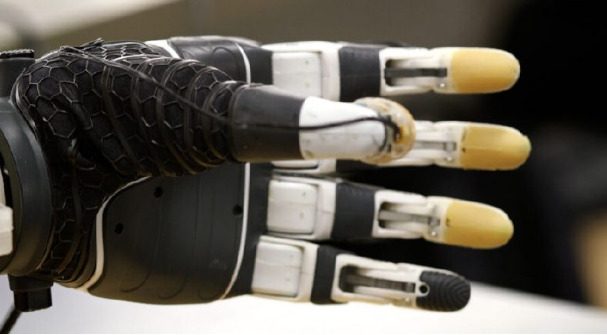
A University in USA has created a hand with an AI brain of its own. The University of Utah engineers created the bionic hand to aid amputees with advanced autonomous capabilities.
According to post-doctoral researcher Marshall Trout, a significant number of amputees—estimated between 20% and 50%—discontinue the use of bionic hands, partly due to the cognitive effort required to operate them.
Professor Jacob George, director of the Utah Neurorobotics Lab, noted, “While we have robotic arms capable of replicating the full range of human hand motions, achieving intuitive and dexterous control remains a challenge.”
In response, Trout, under George’s guidance, enhanced a commercially available prosthetic hand with optical and touch sensors, as well as artificial intelligence.
As the hand approaches an object, its fingers automatically adjust to make contact. The user then employs electrical signals from their muscles to control the grip’s strength. This approach provides a cognitive assist through AI, allowing the amputee to focus on the force applied rather than the precise positioning of the hand. “The AI assists in shaping the hand, while the user determines the force, without needing to manage the intricacies of hand positioning,” George explained. “The human sets the intention, and the AI operates in the background to enhance the seamless integration with the technology.”
Trout reported that this system enables patients to handle objects with greater dexterity and reduced cognitive load. One of the system’s users, Sam Matagi, who lost both hands in a power line accident, described the experience: “It feels like having an assistant. It’s akin to having a crane operator inside your arm.”
George anticipates that this system could be commercially available within five years and expects that sensors and AI will become standard features in prosthetics over the next five to ten years.
The work was part of a study published in the journal Nature Communications.