

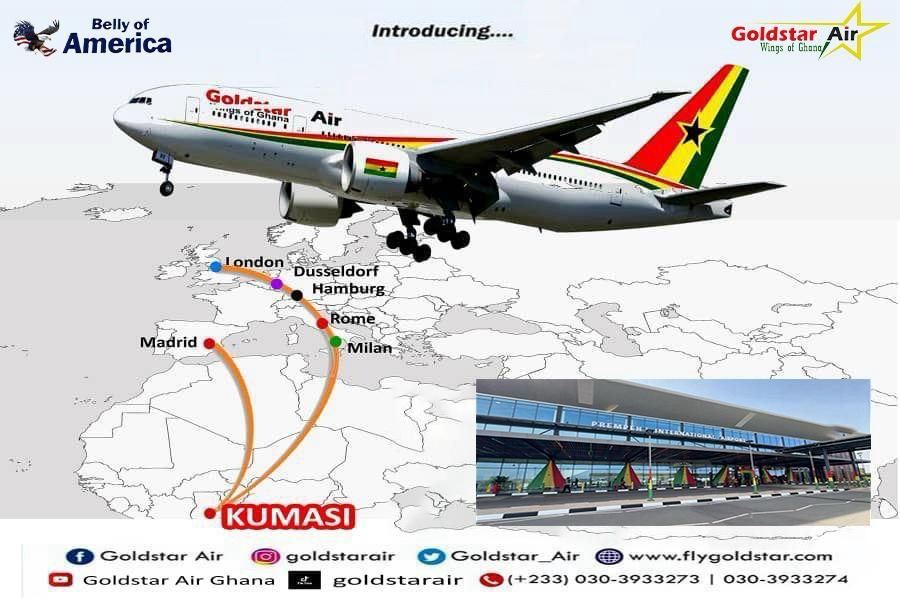
Reputable private international airline Goldstar Air, Ghanaian and United States registered company with an issued Air Carrier Licence (ACL/N-SCH No. 0239) from the Ghana Civil Aviation Authority (GCAA) and no liabilities as of today, has also secured incentives from major airports worldwide. The airline is authorized by its Licence to operate passenger and cargo flights across West Africa and Intercontinental routes, with a clear mission to connect Kumasi to the world and the world to Kumasi.
Goldstar Air’s strategic plan to operate international flights from Kumasi’s newly commissioned Prempeh I International Airport (KMS) signifies not only a monumental step in regional aviation development but also a bold declaration of the airline’s readiness to decentralize air travel in Ghana and stimulate economic growth beyond the capital city. In line with this vision, the management of Goldstar Air has paid a courtesy visit to the Asantehene, Otumfuo Osei Tutu II, to formally notify him of this historic initiative.
The initiative by Goldstar Air, the wings of Ghana and the belly of America, to commence international operations from Kumasi is not merely an operational expansion; it is a powerful symbol of inclusion, empowerment, and economic renewal for an entire region. As Ghana’s aviation landscape evolves, the presence of a Ghanaian-registered carrier operating from Kumasi stands as a testament to strategic foresight and an unrelenting commitment to connecting Ghanaians to global opportunities. The decision is deeply rooted in the vision of equitable development, where Kumasi, the heartbeat of the Ashanti Region and the cultural center of Ghana, also takes its place as a gateway to international trade, tourism, and investment. Goldstar Air is leveraging aviation to create over two million direct and indirect sustainable job opportunities for Ghanaians and to advance the airline’s Project $1 Trillion foreign reserves goal.
The airline’s readiness to operate international flights from Prempeh I International Airport is the culmination of years of meticulous planning, collaboration, and investment in infrastructure, human resources, and strategic partnerships. The city of Kumasi, known for its rich cultural heritage, entrepreneurial dynamism, and strategic central location, has long been recognized as a key economic hub deserving of world-class aviation connectivity. Goldstar Air aims to establish a strong operational base at Prempeh I International Airport to harness Kumasi’s economic potential, transforming it into an international gateway for passengers, goods, and services. This move will decentralize air travel in Ghana, relieve congestion at Kotoka International Airport in Accra, and create a more balanced economic ecosystem where opportunities are shared across multiple regions.
Goldstar Air has sought for international intervention to look into the issuance of the airline’s wide-body aircraft Safety Certificate (AOC) and waiting for the outcome, as the process is above halfway and it has been over eight years that the Ghana Civil Aviation Authority is not willing to authorize a qualified third party to examine and complete the remaining phases of the certification process. Completion of this certification will enable the change of the wide-body aircraft’s nationality, allowing it to be registered under the Ghana Registry (State of Registry) for enabling Goldstar Air to commence operations. The change of aircraft nationality or registration from one state to another is referred to as a cross-border transfer of aircraft. Once the nationality mark is selected, the State notifies the International Civil Aviation Organization (ICAO). The registration mark, assigned by the State of Registry, consists of letters, numbers, or a combination of both. Typically, aircraft are registered in the jurisdiction where the carrier is resident or based and may enjoy preferential rights or privileges as a flag carrier for international operations.
The Kumasi International Airport, now known as Prempeh I International Airport, expansion was undertaken in several phases with significant investment. Phase 2 cost approximately €66.3 Million (about $78.4 Million) for the new terminal and runway extension, while Phase 3 added about £58.9 million for additional runway, apron works, and facilities. These phases form part of a larger project estimated at around $300 Million, designed to handle over one million passengers annually. The project has modernized the airport to accommodate international flights and significant passenger traffic, with the terminal commissioned in May 2024. The Ghana Auditor-General has recommended that the Commercial Services Department of the Ghana Airports Company Limited identify potential concessionaires to occupy idle spaces in order to generate additional revenue through rent and royalties. Therefore, there is no need to delay the issuance of Goldstar Air’s Safety Certificate, which will help kick-start the 24-hour economy and create job opportunities for Ghanaians. The Ghanaian youth cannot wait any longer in the ghettos; they need the airline’s universal pay structure and biweekly, well-paying jobs now.
The new Prempeh I International Airport represents a vision of progress, named in honour of one of the Ashanti Kingdom’s greatest leaders. Its development signals a shift in Ghana’s aviation narrative, one that prioritizes accessibility, regional growth, and the democratization of air travel. Goldstar Air’s decision to operate from this modern facility will serve as a catalyst for regional integration, as the airline plans to initially link Kumasi to major European destinations such as London, Milan, Düsseldorf, Madrid, Rome, and Hamburg, as well as operate direct Hajj flights to and from the Kingdom of Saudi Arabia.
The 24-hour connectivity service will not only boost tourism but also provide new opportunities for trade, business collaboration, and diaspora engagement. Kumasi, as the commercial nerve center of Ghana’s middle belt, will soon be positioned to export local products, attract international visitors, and emerge as a central hub for Ghana’s growing aviation and logistics sectors. This means entrepreneurs can move products from Kumasi to Hamburg or Madrid in under 24 hours. It means the diaspora has direct, culturally affirming connections to home. It means Africa gains new corridors for trade, mobility, and global competitiveness.
Goldstar Air’s 24-hour ambition reflects innovation, diversification, resilience, and a far-reaching strategy, building a reputation not only as an airline but as a private business conglomerate that integrates aviation, logistics, infrastructure development, industrialization, tourism, agriculture, and social empowerment into a single vision. This initiative lays the groundwork for a deeper exploration of how the airline has positioned itself as a business giant whose reach and influence extend across borders, shaping economies, empowering communities, and redefining possibilities for Ghana and Africa at large in the 21st-century global economy.
The aviation industry supports 87.7 million jobs worldwide and contributes $3.5 Trillion (4.1%) to the world’s Gross Domestic Product (GDP). If aviation were a country, it would rank 17th in size by GDP, equivalent to the economies of Indonesia and the Netherlands. In 2024, the tourism industry also contributed $10.9 Trillion (10%) of global GDP. The African continent is currently undergoing major transitions across technology, energy, infrastructure, agriculture, and digital finance. It is projected to become the 8th-largest global economy by 2050 and home to about 2.5 billion people, representing nearly a quarter of the world’s population, with a projected purchasing power of $16.3 Trillion. Goldstar Air’s emerging global dominance has the potential to command significant market share across aviation, tourism, and related industries, thereby contributing meaningfully to GDP growth.
Goldstar Air’s operational readiness at Prempeh I International Airport, Kumasi, is rooted in its broader corporate mission of transforming Ghana into a regional aviation powerhouse. The airline’s strategic model emphasizes not only passenger operations but also the development of robust cargo, maintenance, and aviation training infrastructure. Cargo services will be particularly critical in Kumasi, as the region hosts numerous agribusinesses, artisans, and manufacturing enterprises that stand to benefit from efficient air logistics. Farmers and exporters in the Ashanti, Bono, and Ahafo regions will gain direct access to international markets, reducing costs, increasing export volumes, and enhancing the global competitiveness of Ghanaian products. The airline’s cargo strategy includes the establishment of dedicated freight terminals and cold-chain facilities capable of handling perishable goods, thereby creating an integrated value chain from farm to global consumer.
The economic and social ripple effects of Goldstar Air’s presence in Kumasi will extend far beyond logistics. Job creation remains at the core of the airline’s agenda. The commencement of international operations will generate thousands of direct and indirect employment opportunities, ranging from pilots, cabin crew, and engineers to ground staff, hospitality professionals, and transport operators. Local entrepreneurs will benefit from increased passenger traffic, driving demand for hotels, restaurants, travel agencies, and allied services. This multiplier effect will rejuvenate local economies and empower youth and women, who form the backbone of Kumasi’s informal sector. Furthermore, the presence of a vibrant international airport will attract foreign direct investment, as businesses recognize the logistical advantages of proximity to global supply chains.
Goldstar Air also plans to organize major cultural and tourism home-coming events at the architectural marvel, traditional Asante house design with modern aesthetics, poised to serve as a cultural and ceremonial hub. Commissioned to reflect the essence of Asante heritage, the hall features a striking mural adorned with authentic Asante artifacts and Adinkra symbols, prominently showcasing the revered Golden Stool, Sika Dwa Kofi. The design, inspired by the iconic Fi Hankra Asante housing style, include a spacious 2,000-seat auditorium, complemented by office spaces and dining facilities. These activities will generate significant traffic for Prempeh I International Airport and represent one of many avenues through which Goldstar Air will create indirect employment opportunities for Asanteman youth and Ghana as a whole once operations commence.
The Asanteman youth must be trained to access employment opportunities at Prempeh I International Airport to ensure the project delivers tangible benefits to the region. The initiative is not merely about opening the airport to international passengers and aircraft but about enabling local communities to benefit from the 24/7 economy and the auxiliary jobs created around the airport ecosystem. The primary purpose of opening the international concourse is to create employment for the people of Asanteman, and Goldstar Air stands as the most viable catalyst to make this vision a reality. As an economic tool, Goldstar Air understands how to empower communities to earn more income across aviation, tourism, and related sectors, thereby enhancing economic performance and creating sustainable employment for Ghanaians.
Goldstar Air will adopt a universal pay structure, with salaries paid biweekly, standardizing a single payroll schedule across all locations. The airline will consolidate most global sales through the central bank before disbursement, with the remainder serving as a strategic reserve to strengthen the country’s foreign reserves and help reduce future reliance on the International Monetary Fund (IMF). Employee welfare initiatives will include structured salary savings programs for junior staff, enabling them to purchase imported used vehicles and improve commuting efficiency, thereby supporting high operational standards and service quality. Employees who earn per diem allowances will also be able to save toward purchasing personal motorbikes to reduce commute times. The biweekly pay structure further supports debt reduction and long-term savings, allowing employees to acquire additional vehicles for family use within a relatively short period.
The airline will also assist employees aspiring to own estate houses or apartments by providing guarantees and deducting monthly payments directly from salaries. These initiatives will stimulate increased sales for car dealers and real estate agents across Ghana, contributing to broader indirect job creation. As customer service is central to aviation, Goldstar Air places strong emphasis on caring for its employees, recognizing that a motivated workforce is fundamental to delivering exceptional service.
The Chairman and Chief Executive Officer of Goldstar Air, Eric Bannerman, who received the 2025 Special Award at the 22nd Annual Ghanaian Canadian Achievement Awards Gala, held on Saturday, October 4, 2025, at the Toronto Grand Convention Center, 30 Baywood Road, Etobicoke, Ontario, indicated that the operational readiness of Goldstar Air from Kumasi also embodies the airline’s deep respect for Ghanaian heritage and identity. Naming the airport after Otumfuo Osei Tutu Agyeman Prempeh I carries historical weight, as it honours the resilience and leadership of one of Ghana’s most revered traditional rulers. By integrating cultural heritage into modern infrastructure, Ghana communicates to the world that development and tradition can coexist harmoniously. Goldstar Air’s involvement will strengthen this symbolism, as it will represent a fusion of modern aviation technology with Ghanaian values of excellence, hospitality, and community. Each aircraft bearing the names of prominent personalities becomes an ambassador of culture, carrying the story of a nation rising with unity and determination.
Aviation has historically been the backbone of globalization, and positioning Goldstar Air within this industry, the company has strategically placed itself at the very center of the global economy. Airlines do not merely transport passengers and cargo; they connect cultures, open trade routes, and stimulate economic activity across multiple sectors. Goldstar Air’s entry into aviation immediately placed it among global competitors, for in the skies, competition is not regional but international. The airline, however, distinguished itself by adopting a model that integrates cargo, passenger transport, and logistics into a seamless system, ensuring that it is not limited to a single revenue stream but is equipped to compete holistically within a highly volatile industry.
The success of Goldstar Air’s operations from Kumasi will depend on its comprehensive investment in human capital development. The airline will establish an Aviation Training Institute to train pilots, engineers, air traffic controllers, and flight attendants, ensuring that Ghana develops its own pool of highly skilled aviation professionals. By training local talent, Goldstar Air not only reduces reliance on expatriate expertise but also provides sustainable career paths for young Ghanaians. The training center will be a cornerstone of the company’s long-term vision to position Ghana as a regional leader in aviation education and innovation.
The airline’s dedication to corporate social responsibility will extend to the Kumasi community and beyond. Goldstar Air has consistently demonstrated a commitment to uplifting lives through initiatives in education, healthcare, sports, and environmental sustainability. The airline’s entry into Kumasi will include programs aimed at supporting schools, sponsoring skills development initiatives, and contributing to the overall well-being of the community. These social interventions are designed to complement the economic transformation that the aviation sector will bring, ensuring that development is holistic and inclusive.
Goldstar Air’s readiness to commence international operations from Prempeh I International Airport, Kumasi, also reflects its strong partnerships with local and international stakeholders. The airline will collaborate with the Ghana Civil Aviation Authority, Ghana Airports Company Limited, and other aviation bodies to ensure that all operations meet international safety and service standards. Goldstar Air, the wings of Ghana and belly of America, through its partnerships with global aviation service providers, further ensures that passengers experience world-class hospitality and reliability. This integration of local authenticity with international excellence forms the foundation of Goldstar Air’s brand promise, one that resonates with both pride and global ambition.
The airline’s strategic foresight supports the decentralization of growth by empowering regional capitals to play active roles in national transformation. The establishment of Kumasi as a second international gateway strengthens Ghana’s competitiveness in West Africa, complementing Accra’s global connectivity while reducing dependence on a single city for international travel. In addition, Goldstar Air’s commitment to sustainability will play a significant role in shaping its future operations. The airline has pledged to implement eco-friendly practices by adopting modern, fuel-efficient aircraft and exploring the use of sustainable aviation fuels. Its operational base in Kumasi will also prioritize waste management, energy efficiency, and green airport initiatives, aligning with global efforts to reduce the aviation industry’s carbon footprint. This commitment to environmental stewardship underscores Goldstar Air’s recognition that economic development and ecological responsibility must progress hand in hand.
The symbolic and practical significance of Goldstar Air operating from Kumasi goes beyond aviation. It will represent a national awakening, a recognition that Ghana’s potential lies not only in its capital but also in the collective strength of its regions. It will signal to investors, tourists, and citizens alike that the Ashanti Region is open for global engagement. The cultural pride associated with Kumasi, the seat of the Ashanti Kingdom, adds depth to this development. Visitors arriving at Prempeh I International Airport will not only experience modern aviation but also encounter the rich traditions, art, and hospitality of the Ghanaian people. This unique blend of tradition and modernity will make the Kumasi experience truly distinctive.
Goldstar Air’s role as a global symbol of ambition, resilience, and excellence becomes more pronounced as preparations advance. The airline’s readiness is not simply about flight schedules or airport logistics; it is about a broader vision of using aviation as a catalyst for economic progress. The expansion into Kumasi reinforces Goldstar Air’s identity as a global brand rooted in community development, innovation, and economic empowerment. The airlines operations from Prempeh I International Airport will breathe new life into the aspirations of millions who believe in Ghana’s potential to lead Africa into a new era of prosperity and connectivity.
The transformation Goldstar Air seeks to deliver through Prempeh I International Airport extends beyond the skies. It embodies a renewal of national consciousness, an understanding that true progress is achieved when every region contributes to and benefits from growth. As the first flights prepare to soar from Kumasi to the world, they will carry not only passengers but also the collective hopes of a people determined to define their destiny through self-reliance and excellence. Each takeoff will symbolize opportunity, each landing a connection, and each journey a testament to what Ghana can achieve when vision meets commitment.
Goldstar Air’s readiness to operate international flights from Kumasi marks a defining moment in Ghana’s aviation history. It bridges past aspirations with future possibilities, reaffirming the belief that Ghana can build and sustain a world-class aviation ecosystem led by its own people. The airline’s expansion will reflect not just business growth but a renaissance, one that unites innovation, culture, and enterprise under Ghanaian values. With Kumasi positioned as a global cultural hub, the skies above Ghana will tell a new story: one of courage, collaboration, and boundless potential, propelled by the wings and belly of Goldstar Air.
Tourism, another frontier of Goldstar Air’s strategy, expands its profile into the cultural and service industries. Airlines have historically been catalysts for tourism, but Goldstar Air envisions itself as a direct promoter rather than merely a facilitator. By marketing the Ashanti Region as a destination for weddings, conferences, agro-tourism, and cultural experiences, Goldstar Air will invest across the global tourism value chain for Ashanti Region to tap into the $10.9 Trillion tourism economy. This approach diversifies the airline’s role from a carrier of tourists to a creator of tourism experiences. Goldstar Air’s efforts to develop agro-tourism, where agricultural projects are integrated into tourism experiences, highlight its innovative capacity to create hybrid industries that attract global attention while stimulating local development.
Mr. Bannerman emphasized that the airline’s 24-hour operational model is well positioned to address the challenges highlighted in the latest Ghana Auditor-General’s Report on the accounts of public boards, corporations, and other statutory institutions for 2023. The report indicated that Ghana’s airports in 2022 generated a combined revenue of GH¢13.13 million, against an expenditure of GH¢39.14 million across five regional airports. The report further recommended the implementation of strategies to improve profitability and become more financially sustainable.
The resulting deficit of GH¢26.01 million has prompted a re-evaluation of strategies to optimize regional airport development and maximize economic benefits. The regional airports include Kumasi Airport (now Prempeh I International Airport) in the Ashanti Region, Tamale Airport in the Northern Region, Wa Airport in the Upper West Region, Sunyani Airport in the Bono Region, and Ho Airport in the Volta Region.
Further breakdown of the data indicated that Kumasi Airport recorded an expenditure of GH¢15.68 million but generated GH¢8.22 million in revenue. Tamale Airport, on the other hand, generated GH¢4.74 million in revenue but incurred a significantly higher expenditure of GH¢15.41 million, while Sunyani Airport accrued GH¢95,626.58 in revenue after spending GH¢4.53 million. Ho Airport, which generated no revenue, recorded an expenditure of GH¢1.38 million in 2022, whereas Wa Airport generated GH¢77,250.48 in revenue and spent GH¢2.15 million on its operations.
The Auditor-General therefore recommended that the management of Ghana Airports Company Limited (GACL) encourage existing and potential domestic airlines to patronize these airports by providing possible incentives. Management was also advised to embark on a robust publicity drive to promote and market the regional airports in order to attract more air travelers. In addition, the Auditor-General recommended that GACL liaise with the appropriate regulatory authorities to reduce regulatory barriers for potential airlines without compromising safety standards.
According to the International Civil Aviation Organization (ICAO), an international airport is one equipped with customs and border control facilities that enable passengers to travel between countries worldwide. ICAO also defines a runway as a rectangular area on a land aerodrome prepared for the landing and takeoff of aircraft. Runways may be human-made surfaces, often asphalt, concrete, or a mixture of both. Runways, taxiways, and ramps are sometimes collectively referred to as “tarmac,” although very few runways are actually constructed using tarmac. Takeoff and landing areas on water designated for seaplanes are generally referred to as waterways.
Runway lengths are now commonly expressed in meters worldwide, except in North America, where feet are still widely used. The runway is one of the most visible and critical components of an airport, and its dimensions (length and width), location, and maintenance must be precise to ensure safety during both takeoff and landing operations.
Existing facilities at Prempeh I International Airport include a single asphalt-paved runway, designated Runway, with a length of 1,981 meters (6,502 feet) and a width of 45 meters (148 feet) for landing and takeoff. The runway is expected to be extended to 2,320 meters (7,611 feet). By comparison, London City Airport operates a single 1,508-meter (4,948-foot) runway that supports both domestic and international passenger flights. Due to its short runway and steep 5.5-degree approach, only multi-engine, fixed-wing aircraft up to the Airbus A318 size, operated by specially certified aircraft and aircrew, are permitted. London City Airport occupies approximately 60 hectares, handles over 5 million passenger movements annually, and ranks as the fifth busiest airport serving the London area after Heathrow, Gatwick, Stansted, and Luton, and the 15th busiest in the United Kingdom, a benchmark that Prempeh I International Airport can aspire to emulate.
Ronald Reagan Washington National Airport currently serves approximately 9,449 flights per month, averaging 315 flights per day, 13 flights per hour, and 111 nonstop destinations. On an average day, there is at least one flight every five minutes. The airport contains four runways; however, the east–west runway was closed in 1956 and converted into a taxiway and aircraft parking area. In 2012, the runway infrastructure was resurfaced and extended to enhance safety areas. The main north–south runway now measures 2,185 meters (7,169 feet), the northwest–southeast runway 1,586 meters (5,204 feet), and the northeast–southwest runway 1,524 meters (5,000 feet). Slot controls limit aircraft movements to 62 landings and takeoffs per hour.
Although Reagan National is classified as an international airport, it does not have full immigration or customs facilities. International flights are restricted to destinations with U.S. Customs and Border Protection preclearance, including major airports in Canada and select Caribbean destinations. Most international passenger traffic serving the Washington metropolitan area is handled by Washington Dulles International Airport or Baltimore/Washington International Airport. Reagan National served 26.29 million passengers in 2024, representing a 3.3% increase over the previous record set in 2023, and its main runway is among the busiest in the United States.
There will be an initial limitation on the operation of Goldstar Air’s Boeing 777 aircraft to and from China and North America at Prempeh I International Airport now, as the airline anticipates further runway expansion beyond the projected 2,320 meters to one that can accommodate all the company’s aircraft in the future. The minimum runway length typically required for Boeing 777 takeoffs is 2,500 meters, in addition to a 240-meter Runway End Safety Area (RESA), designed to safely arrest an aircraft in the event of an aborted takeoff.
Goldstar Air, the wings of Ghana and belly of America, will employ innovative strategies to give Prempeh I International Airport global recognition. The airline assures the Ghanaian traveling public that the existing 1,981-meter runway is sufficient and safe for current international operations. Goldstar Air’s narrow-body aircraft are capable of operating flights to and from the Prempeh I International Airport to European destinations and Saudi Arabia for Hajj pilgrimage services until runway expansion is completed to accommodate wide-body aircraft operating to and from North America.
Overall, for accessibility and connectivity, Prempeh I International Airport must rely on Ghanaian-registered airlines such as Goldstar Air for its success, alongside businesses operating within the airport ecosystem. Creating a positive passenger experience will be essential in attracting customers, encouraging repeat travel, and generating long-term growth and sustainability.
Ghana must shift toward greater local participation in aviation to achieve sustainable job creation within the sector and ensure the equitable distribution of profits within the country, thereby bolstering economic growth. The Ashanti Region can generate significantly more revenue annually by instituting a 24-hour economy to drive growth and advancement, which will also help reduce the national unemployment rate. Ghana must take advantage of its strategic location as the center of the world to position itself as an attractive destination for investment, fostering economic growth, creating well-paying job opportunities, and contributing to the development of its citizens.
Goldstar Air stands ready to deliver a travel experience that blends world-class aviation, African pride, and a renewed spirit of Pan-African unity rooted in the vision of Dr. Kwame Nkrumah, a united, self-sufficient Africa. Every mile flown aligns with Goldstar Air’s foundational vision: achieving the airline’s $1 Trillion foreign reserves goal and supporting Africa’s role in shaping its projected $16.3 trillion GDP by 2050. The joy the airline promises is grounded in world-class service enriched by Ghanaian warmth, while the sense of discovery lies in the creation of new high-speed corridors connecting Africa to the world.
Economic development experts view aviation as crucial to national progress and as a critical driver of income generation and economic growth. The viability of Wa and Ho Airports will be strengthened by Goldstar Air’s 24-hour economic activities and charter operations, positioning them as major economic drivers for the Upper West and Volta Regions of Ghana. Additionally, the introduction of Hajj flights to and from the Kingdom of Saudi Arabia will create new economic opportunities for these regional capitals, further connecting rural communities to global commerce, supporting local businesses, and attracting new investments.
Tamale will serve as a pivotal hub for Goldstar Air’s universal maintenance base, aviation training school, catering services, and global cargo village. Plans are also underway to operate international passenger flights between Tamale and key destinations in the Sahel region, as well as Hajj flights to and from the Kingdom of Saudi Arabia.
Flights from Accra will include destinations such as Washington, Dubai, Lagos, Toronto, Monrovia, Conakry, Abidjan, Guangzhou, Dakar, Banjul, Rhode Island, London, and Freetown. Future expansion plans include cities such as Miami (Florida), Atlanta (Georgia), Chicago (Illinois), Glasgow (Scotland), Houston (Texas), and many others.
#Flygoldstar
#WingsOfGhana
#BellyOfAmerica
#OverTwoMillionJobOpportunities