

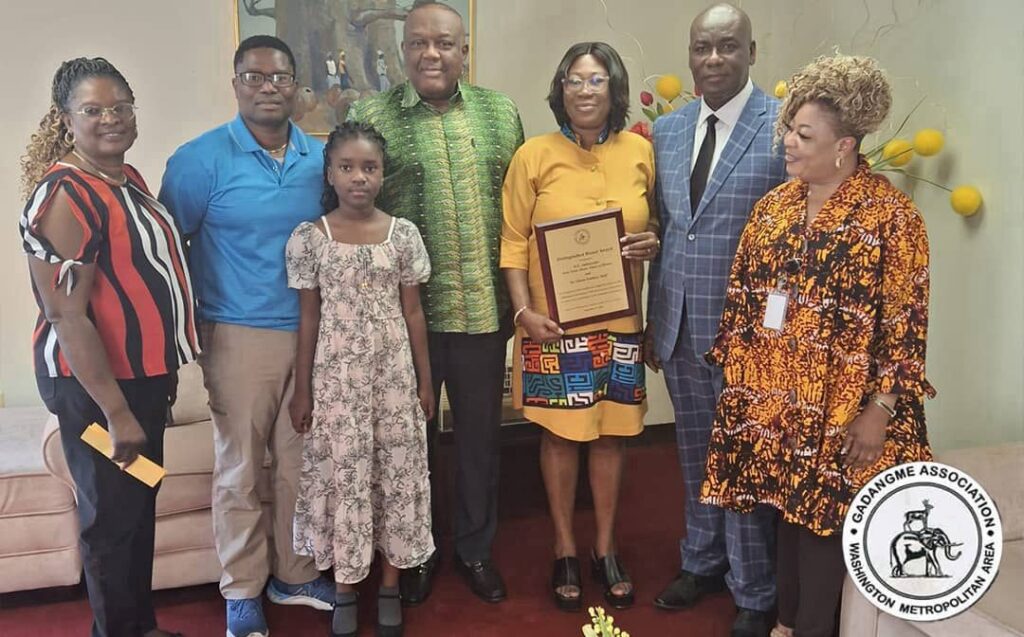
A delegation from the GaDangme Association of the Washington, D.C. Metro Area, led by the Chairwoman, Rowina Naa Odarkai Lamptey Moses, paid a courtesy visit to the Embassy of Ghana in Washington, D.C., to welcome Ghana’s Ambassador to the United States, His Excellency Victor Emmanuel Smith. Other members of the delegation included Mrs. Gladel Kumi, Mr. Obed Sackey, Mrs. Jacklyn Odamtten Addy, Ms. Hanna Gyasi-Adonten, Ms. Linda Sackey, and Mr. Eric Bannerman. A Distinguished Honor Award was presented by the Association to the Deputy Head of Mission, Ambassador Jane Gsau Aheto, a staff member of the Embassy and Special Guest of Honor for the 40th Anniversary Dinner Dance Celebration.
The Embassy of Ghana in Washington, D.C. is the diplomatic mission of the Republic of Ghana to the United States. It is located at 3512 International Drive Northwest, Washington, D.C. 20008, in the Cleveland Park neighborhood. It serves as the flagship of Ghana’s public diplomacy in the United States and is one of Ghana’s largest missions in the world, acting as the official link between Ghana and the United States.
According to the Chairwoman of the Association, Rowina Naa Odarkai Lamptey Moses, the visit symbolized respect for leadership, acknowledgment of shared goals, and a reaffirmation of the commitment of the GaDangme people toward Ghana’s development and representation abroad. It was more than a diplomatic engagement; it was an affirmation of unity, heritage, and the enduring bond between the homeland and its people in the diaspora. The visit reflected cultural dignity, patriotism, and collective vision, an embodiment of the Ghanaian identity in the heart of America.
The Association’s interaction with the Ambassador extended beyond ceremonial formalities. It represented a dialogue of purpose, between the custodians of cultural heritage and the envoy charged with advancing the nation’s interests on foreign soil. Through this meeting, the Association demonstrated not only its relevance as a diasporan institution but also its role as a bridge connecting generations, cultures, and communities across continents. The encounter encapsulated diplomacy, history, and humanity, becoming an exchange of ideas rooted in a common destiny and an expression of solidarity that resonated deeply within the Ghanaian diaspora.
Ambassador Victor Emmanuel Smith is a seasoned Ghanaian politician, diplomat, statesman, and investment consultant whose distinguished career spans over three decades of public service, diplomacy, and private-sector advisory. With an exceptional blend of political acumen, diplomatic tact, and strategic foresight, he has served Ghana with distinction both at home and internationally. His professional footprint covers a high portfolio of high-level leadership roles, including serving as Ghana’s High Commissioner to the United Kingdom and the Republic of Ireland, Ambassador to the Czech Republic, Hungary, and Slovakia, Eastern Regional Minister, and Presidential Advisor across three administrations. In each of these roles, Ambassador Smith has demonstrated integrity, strong leadership, and the ability to manage complex negotiations while facilitating investments of national importance.
As CEO of Victor Smith & Associates, he has played a key role in catalyzing foreign direct investment into West Africa, brokering deals exceeding US$250 million in sectors such as energy, mining, agribusiness, and infrastructure. His work continues to support investors in navigating political and regulatory landscapes across the sub-region. His diplomatic engagements have significantly elevated Ghana’s global profile, notably achieving an 18% increase in bilateral trade between Ghana and the UK during his tenure as High Commissioner. He is also credited with launching high-impact diaspora outreach programs and strengthening B2B collaborations through platforms such as the Ghana–Central Europe Business Council. Academically, he holds an MBA in International Business from the University of Wales Business School and a BSc (Hons) in Maritime Studies, making him a well-rounded professional whose intellectual preparation reinforces his effective diplomacy and leadership.
The GaDangme Association of the Washington, D.C. Metro Area stands as one of the most vibrant and enduring Ghanaian organizations abroad, preserving the rich traditions of the Ga and Dangme people while fostering unity among Ghanaians and Africans in the United States. Its visit to the new Ambassador represented continuity, a gesture of welcome, and an expression of the community’s readiness to collaborate in advancing Ghana’s national agenda. In Ghanaian culture, a courtesy visit is not merely an official act, it is an expression of respect and communal connection. It signifies acknowledgment of authority, goodwill, and the desire to strengthen relationships. The Association’s call on the newly appointed Ambassador therefore carried deep meaning: respect for leadership, continuity of partnership, and an appreciation of the critical role diplomacy plays in connecting the diaspora to the homeland.
The visit highlighted how the Ghanaian diaspora continues to contribute to the nation’s diplomatic, cultural, and economic growth. The GaDangme people, known for their deep sense of identity and their contributions to Ghana’s history, maintain unity abroad through efforts to preserve their heritage, support development, and promote national causes. The courtesy visit served as a bridge between culture and diplomacy, a moment where traditional values converged with modern governance, enabling the voices of community leaders to resonate within national representation. The newly appointed Ambassador, as the face of Ghana in the United States, embodies the nation’s aspirations in trade, investment, cultural diplomacy, and global engagement. Meeting with the GaDangme Association therefore offered a platform to explore areas of mutual collaboration where the strength of the diaspora could be harnessed for Ghana’s development.
The significance of the visit also lies in its demonstration of cultural diplomacy. The GaDangme people, whose roots lie in Ghana’s coastal and eastern regions, form an essential part of the national identity. Their traditions of hospitality, respect, and communalism reflect the broader Ghanaian values. By engaging directly with the Ambassador, the Association showcased the enduring relevance of culture in diplomacy. Cultural associations serve as conduits of soft power, enhancing Ghana’s visibility, fostering goodwill, and creating networks of influence that benefit both the diaspora and the homeland. Through engagements such as this, the GaDangme Association ensures that Ghanaian identity remains visible, respected, and celebrated globally.
Chairwoman Naa Odarkai Lamptey further stated that the meeting also carried a strong emotional undertone: the pride of seeing one’s homeland represented at a high diplomatic level, the joy of reconnecting with symbols of national authority, and the satisfaction of contributing to national progress from afar. The GaDangme community, like many Ghanaian groups in the diaspora, understands that the Ambassador’s role is not merely administrative but inspirational. The diplomat embodies the nation’s voice abroad, and to Ghanaians in America, that voice is a reminder of belonging, representation, and hope. The Association’s engagement therefore transcended political formality, becoming an act of cultural and emotional renewal, a reaffirmation that they remain part of Ghana’s ongoing story of unity, progress, and global participation.
Beyond cultural and emotional symbolism, the courtesy visit had practical implications. It created an avenue for dialogue on key national and diaspora issues such as economic investment, youth engagement, education, cultural preservation, and community development. The GaDangme Association has consistently demonstrated its commitment to contributing to Ghana’s development through its programs and initiatives. By meeting the Ambassador, the Association sought to align its efforts with national goals, ensuring that its projects abroad complement government priorities. Such collaboration strengthens the collective impact of diaspora engagement, turning individual and community efforts into measurable national progress. The Ambassador, in receiving the delegation, acknowledged the immense value of this partnership, a partnership that transforms the diaspora from passive observers into active contributors to Ghana’s future.
The visit also underscored the role of the Ghanaian Embassy in the United States as a home for all Ghanaians abroad. For the GaDangme Association, the engagement reaffirmed their connection to national institutions. The Embassy serves as the official link between the government and its citizens in the diaspora, providing services, guidance, and representation. By visiting the new Ambassador, the Association demonstrated trust, respect, and readiness to collaborate in promoting Ghana’s image and protecting the welfare of its citizens. This unity between the Embassy and the diaspora is essential in a global landscape where national image, citizen engagement, and international cooperation shape a country’s success. The courtesy visit was therefore not just a gesture of goodwill; it was a declaration of unity and a testament to the collective effort required to advance Ghana’s progress across borders.
The GaDangme Association’s presence at the Embassy also symbolized the continuity of traditional leadership within modern governance structures. The GaDangme people hold their traditions and chieftaincy institutions in high regard, and their leaders are respected as custodians of wisdom and culture. By engaging with the Ambassador, the Association was not only presenting itself as a social group but also as an extension of Ghana’s traditional authority abroad. This interplay between traditional and modern leadership exemplifies the inclusive nature of Ghana’s social fabric, where chiefs, community leaders, and diplomats all play vital roles in shaping national identity and promoting progress. The Association’s respect for authority and adherence to protocol reflect the Ghanaian cultural values of respect, order, and humility, values that strengthen national cohesion.
Another important dimension of the courtesy visit is its reflection of the GaDangme people’s historical contribution to Ghana’s development. The Ga and Dangme communities have played significant roles in the nation’s political, educational, and economic history. From pre-colonial times through independence and into modern Ghana, the GaDangme people have been instrumental in shaping national discourse and identity. The Association’s continued activity in the diaspora demonstrates their ongoing relevance and commitment to national unity. The meeting with the Ambassador was therefore also symbolic of history reconnecting with the present, a reminder that the legacy of leadership, service, and nation-building continues even beyond Ghana’s borders. The Association’s presence is a testament to the resilience and global reach of Ghanaian culture, a reminder that national identity transcends physical boundaries.
The encounter also highlighted the economic potential of diaspora communities and the crucial role of remittances and investment in national development. The GaDangme Association, like many other Ghanaian organizations abroad, contributes significantly to the economy through remittances, charitable projects, and development partnerships. The courtesy visit provided an opportunity to discuss structured collaborations that could enhance these contributions, including investments in real estate, agriculture, tourism, and education. The Ambassador, as a facilitator of trade and investment, represents a critical link in transforming these community initiatives into national gains. By strengthening relationships with associations such as the GaDangme group, the Embassy can leverage the diaspora’s expertise, resources, and networks to drive Ghana’s growth agenda. This exchange of ideas and potential partnerships gives meaning to the diplomatic relationship between Ghana and its diaspora, a relationship rooted in shared responsibility and mutual progress.
In a deeper sense, the GaDangme Association’s visit to the Ambassador served as an affirmation of identity. Living in a multicultural society like the United States, Ghanaians often face the challenge of preserving their heritage while integrating into a broader social and professional environment. Associations like GaDangme provide a platform for maintaining language, customs, and traditions, ensuring that the younger generation remains connected to their roots. Meeting with the Ambassador reinforces this identity by reconnecting the diaspora with official representation from home, reminding them of who they are and where they come from. It also instills pride in the younger generation, showing them that being Ghanaian is not only an identity but also an honor. Through such engagements, the Association ensures that cultural heritage is not lost in migration but celebrated and passed on.
Chairwoman Naa Odarkai Lamptey emphasized that the visit was also an opportunity for unity beyond ethnicity. Although the GaDangme Association represents a specific ethnic group, its values and activities are inclusive, promoting national unity among all Ghanaians. The courtesy visit was therefore not limited to GaDangme interests; it symbolized the unity of all Ghanaians abroad under one flag, one mission, and one identity. The Ambassador, representing the entire nation, embodies this unity, and the GaDangme Association’s visit exemplified the cooperative spirit that drives Ghanaian solidarity abroad. It was an act of national cohesion in motion, where culture meets citizenship and where heritage strengthens the national bond..
The Ambassador’s reception of the GaDangme delegation also carried diplomatic symbolism. Diplomacy is not only about international treaties and policies; it is also about human relationships. The warmth, respect, and mutual understanding displayed during such visits build bridges that formal agreements cannot. For the Ambassador, welcoming the GaDangme Association meant opening the Embassy’s doors to community engagement, inclusivity, and partnership. It reinforced the idea that every Ghanaian, whether in Accra or Washington, D.C., is part of the national family. For the Association, the meeting reaffirmed their voice, their presence, and their influence in national discourse. Such interactions cultivate trust, encourage collaboration, and inspire collective patriotism.
At a broader level, the courtesy visit was a demonstration of the role of the diaspora in national image-building. The conduct, achievements, and unity of Ghanaians abroad reflect directly on the nation’s reputation. The GaDangme Association, through its programs in community service, education, and cultural promotion, projects a positive image of Ghana in the United States. Their meeting with the Ambassador further strengthened this role, creating avenues for cultural exchanges, tourism promotion, and educational collaboration. These soft-power initiatives contribute to Ghana’s global image, attracting goodwill, partnerships, and opportunities. In essence, every handshake, every conversation, and every moment of cultural exchange during the visit served as a diplomatic gesture promoting Ghana’s beauty, civility, and hospitality.
Furthermore, the visit highlighted the evolving role of diaspora organizations in shaping national policies. Modern diplomacy recognizes that diaspora communities are no longer peripheral to national development; they are active players in shaping economies, politics, and social transformation. The GaDangme Association’s interaction with the Ambassador was therefore not only ceremonial but strategic. It reflected a growing awareness that Ghana’s progress depends on inclusive engagement with its citizens abroad. The Association, with its leadership and experience, represents a voice of influence that can contribute ideas, advocate for policies, and mobilize resources. This form of participatory diplomacy bridges the gap between government and its people, ensuring that national representation reflects the aspirations of Ghanaians everywhere.
The spiritual and emotional undertones of the courtesy visit cannot be overlooked. Ghanaian culture is deeply spiritual, and every act of respect, unity, or engagement carries a sense of divine acknowledgment. The GaDangme Association’s visit was, in many ways, an act of blessing, a symbolic gesture of goodwill for the Ambassador’s new role. It was a reminder that leadership, whether political or diplomatic, thrives on the blessings, prayers, and support of the people. By presenting themselves before the Ambassador, the Association offered not only congratulations but also spiritual encouragement, reinforcing the Ghanaian belief that leadership is service guided by divine grace and community trust. This cultural dimension adds depth to the diplomatic relationship, humanizing it and grounding it in shared values of faith and gratitude.
The GaDangme Association’s courtesy visit to Ghana’s newly appointed Ambassador to the United States will remain a defining moment of cultural diplomacy, community solidarity, and national identity. It was a meeting of hearts and minds, rooted in history and inspired by a shared vision of Ghana’s progress. It demonstrated how the diaspora continues to uphold Ghana’s name abroad, how cultural heritage remains central to national pride, and how unity between people and leadership strengthens the nation’s global presence. For the GaDangme people of Washington, D.C., this was not merely a visit, it was a reaffirmation of purpose, a declaration of belonging, and a celebration of Ghanaian excellence abroad. For the Ambassador, it was a reminder of the people’s faith, support, and expectations, a call to leadership that serves both nation and diaspora with integrity and vision.
Ultimately, the significance of this courtesy visit transcends time and place. It is a reflection of what it means to be Ghanaian, respectful, united, forward-looking, and proud. It symbolizes how the roots of tradition can flourish even in foreign lands, how identity can serve as a source of strength, and how diplomacy can become a bridge for cultural and national advancement. The GaDangme Association of the Washington, D.C. Metro Area, through this gesture, reaffirmed that no matter where Ghanaians live, the call to serve, to connect, and to honor their homeland remains unbroken. The newly appointed Ambassador’s reception of this visit represents a renewal of hope, unity, and shared destiny, a bond between a people and their nation that neither distance nor time can erode.