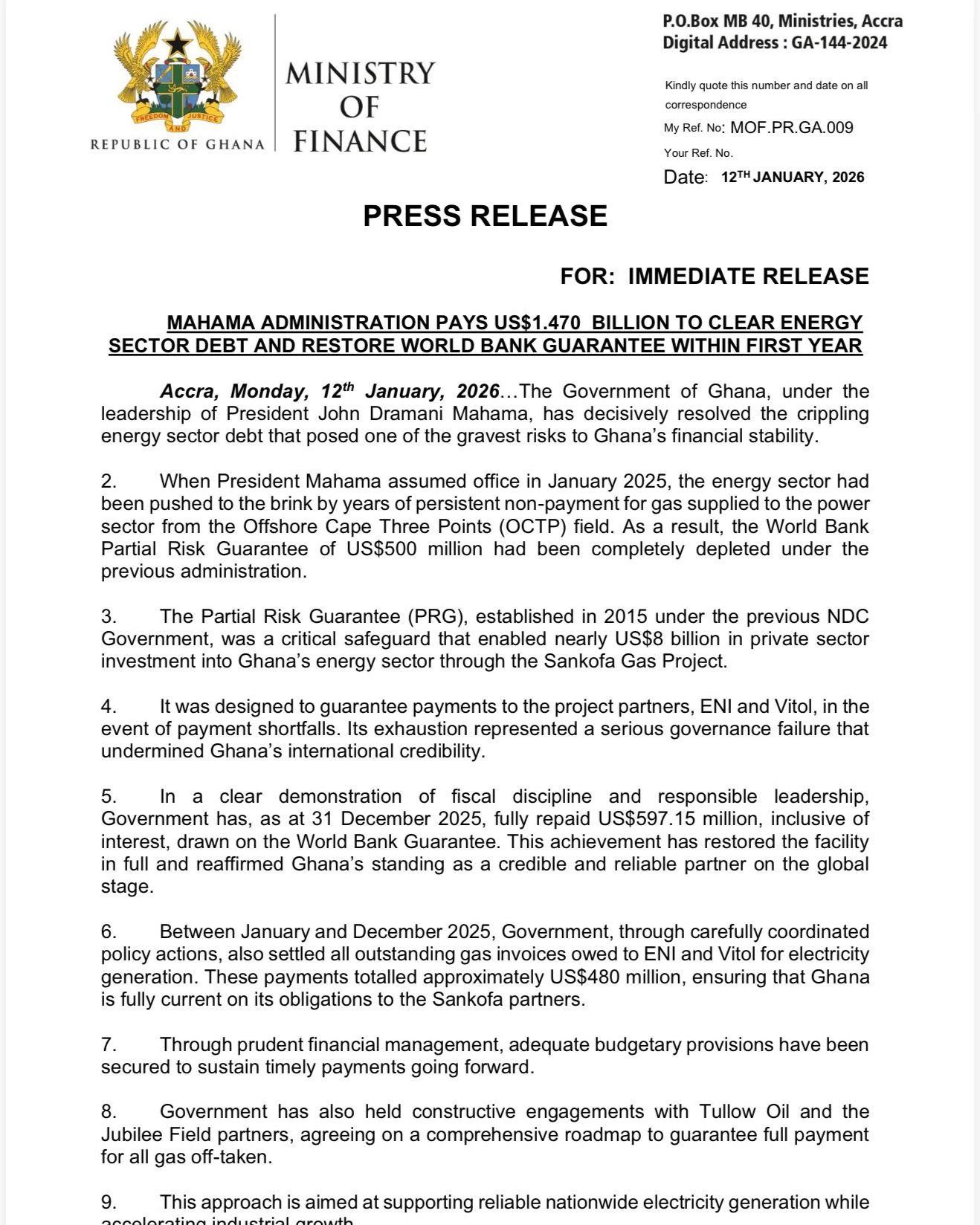


Finance Minister Cassiel Ato Forson said the government spent US$1.47 billion in 2025 to clear legacy energy sector debt, restore a World Bank payment guarantee, and neutralize one of the economy’s most significant fiscal risks.
When President Mahama took office in January 2025, the energy sector was burdened by unpaid gas invoices across the value chain, particularly for supplies from the Offshore Cape Three Points (OCTP) Sankofa field. The payment failures had exhausted a US$500 million World Bank Partial Risk Guarantee (PRG), triggering concerns over Ghana’s contractual credibility and its ability to attract private capital.
The PRG, established in 2015, had been central to mobilizing nearly US$8 billion in private investment for the Sankofa Gas Project. Its full drawdown was widely seen by lenders as a warning sign of governance and payment discipline risks.
As of December 31, 2025, the government had fully repaid US$597.15 million, including interest, drawn under the guarantee, restoring the facility in full, the finance ministry said. Officials say the move has reset Ghana’s standing with international financiers and project partners.
The government also settled all outstanding gas invoices owed to ENI and Vitol in 2025, with payments totalling about US$480 million. Budgetary provisions have been secured to keep payments current, the finance minister said, in an effort to prevent a repeat of the arrears cycle.
Separately, the government reached agreements with Tullow Oil and Jubilee Field partners on a structured payment roadmap for gas off-take, contributing to higher gas output and reducing reliance on more costly liquid fuels for power generation.
A major component of the clean-up involved legacy debts to Independent Power Producers (IPPs), long a source of contingent liabilities. In 2025, the government paid about US$393 million after renegotiating power purchase agreements to improve value for money.
Payments were made to Karpowership Ghana Co. Ltd, Cenpower Generation Co. Ltd, Sunon Asogli Ghana Ltd, AKSA Energy Ltd and several other producers, clearing arrears that had strained relations with suppliers and raised the risk of supply disruptions.
Altogether, the finance ministry estimates that US$1.47 billion was disbursed in the 2025 fiscal year to stabilize the energy sector and ring-fence it from spilling over into the broader economy.