

International private airline Goldstar Air, a United States and Ghanaian registered company with an issued Air Carrier Licence (ACL/N-SCH No. 0239) from the Ghana Civil Aviation Authority (GCAA) and no liabilities as of today, has also secured incentives from major airports worldwide. The airline, authorized by its Licence to operate passenger and cargo flights across West Africa and on intercontinental routes, will deliver a 24-hour service that stands as a transformative vision, extending far beyond the realm of aviation. Goldstar Air has positioned itself as a comprehensive solution to many of Ghana’s enduring socio-economic challenges. In a nation endowed with human talent, natural resources, entrepreneurial spirit, and a strategic geographic location, the persistence of unemployment, underemployment, logistics bottlenecks, limited market access, youth disenfranchisement, a minimum wage of less than US$2 per day, and uneven regional development has often been traced not to a lack of potential but to systemic inefficiencies and constrained connectivity. The concept of a fully operational, round-the-clock (24/7) airline ecosystem, anchored by Goldstar Air’s commitment to excellence, reliability, and African-led global standards, represents a structural shift capable of unlocking dormant value across multiple sectors of the economy. This shift will bring wealth to Ghanaians and support the airline’s Project US$1 Trillion foreign reserves goal, as Goldstar Air wants to be recognized among the best one hundred (100) companies in Africa.
The airline’s 24-hour service is not merely about aircraft flying at night or cargo moving after sunset. It is about redefining time as an economic asset, ensuring that opportunity is not limited by daylight hours, bureaucratic delays, or infrastructural inertia. The services sector continued to be the largest sector of the Ghanaian economy in Q2 2024, accounting for 44.2 percent of GDP at basic prices. Goldstar Air’s 24-hour vision of continuous operations will transform Ghana into an economy that never sleeps, where transport operators, farmers, traders, manufacturers, students, professionals, creatives, and entrepreneurs are empowered to participate fully in local, regional, and global markets at any time. This vision aligns with the realities of the modern global economy, which operates across time zones and where competitiveness is determined by speed, reliability, and responsiveness rather than proximity alone. For Ghana, the implications of such a service by Goldstar Air, the wings of Ghana and belly of America, are profound. Aviation sits at the intersection of trade, tourism, employment, education, healthcare, diplomacy, and cultural exchange. The airline’s uninterrupted service delivery will effectively become an economic circulatory system, continuously moving people, goods, ideas, and capital continuously. Goldstar Air’s 24-hour operational philosophy therefore represents a panacea not in the simplistic sense of a cure-all, but as a catalytic force that addresses root causes of stagnation by enabling productivity, inclusion, and scale. The airline pledges its 24-hour direct and indirect services to Ghana, with all its strength and all expertise, and promises to hold in high esteem the heritage won for the nation through the blood and toil of our fathers and pledge in all things to uphold and play a crucial role in creating over two million well-paying job opportunities in Ghana.
Goldstar Air has sought international intervention to look into the issuance of the airline’s wide-body aircraft Safety Certificate (AOC) and waiting for the outcome, as the process is above halfway and it has been over eight years that the Ghana Civil Aviation Authority is not willing to authorize a qualified third party to examine and complete the remaining phases of the certification process. Completion of this certification will enable the change of the wide-body aircraft’s nationality, allowing it to be registered under the Ghana Registry (State of Registry) and for Goldstar Air to commence operations. The change of aircraft nationality or registration from one state to another is referred to as a cross-border transfer of aircraft. Once the nationality mark is selected, the State notifies the International Civil Aviation Organization (ICAO). The registration mark, assigned by the State of Registry, consists of letters, numbers, or a combination of both. Goldstar Air is also looking forward to a similar directive given by the President of Ghana, His Excellency John Dramani Mahama during the University of Mines and Technology (UMaT) 18th Special Congregation held on Friday, February 7, 2026, to the Minerals Commission to immediately issue a mining licence to UMaT to enable it operate its model small-scale mine.
Parliament has officially passed the 24-Hour Economy Authority Bill, 2025 into law, providing statutory backing for the implementation of the government’s flagship 24-Hour Economy and Accelerated Export Development Program. Ghana’s real challenge, beyond high unemployment, is underemployment, which affects a staggering 83 percent of the workforce, leading to reduced income, lower productivity, and widespread job dissatisfaction. Goldstar Air’s innovative solution offers over two million direct and indirect job opportunities with a dollar-based, biweekly universal living-wage pay structure, poised to revolutionize the economy. Latest figures show the country’s per capita income is approximately US$3,200, with a minimum wage of less than US$2 per day. This is a stark contrast to the daily expenses of pets in more developed countries. To address these issues, urgent action is necessary to transition Ghana’s minimum wage of less than US$2 a day to a living wage. Therefore, there is no need to delay the issuance of Goldstar Air’s Safety Certificate, which will help kick-start the 24-hour economy and create sustainable job opportunities for Ghanaians. The Ghanaian youth cannot wait any longer in the ghettos; they need the airline’s biweekly, well-paying jobs now.
Goldstar Air aims to revolutionize Ghana’s aviation and tourism industries by setting new standards for safety, comfort, reliability, and on-time departures. The airline will serve as a powerful ambassador for Ghana’s products and services, improving the country’s Gross Domestic Product (GDP) through the expansion of key service sectors. Goldstar Air has created a more equitable company where every employee will enjoy job security, a decent standard of living, and the opportunity to own their dream home soon after receiving a job offer. Globally, the aviation industry supports US$3.5 trillion, representing 4.1 percent of world Gross Domestic Product (GDP). If aviation were a country, it would rank 17th in size by GDP. That equates to the GDP of Indonesia and the Netherlands and supports 87.7 million jobs worldwide.
Examining the worth of some global market revenues, such as Aviation (US$3.5 Trillion), Chocolate (US$150 Billion), Tourism (US$10.9 Trillion), Gold Ornament (US$100 Billion), Fashion (US$3 Trillion), Beauty and Makeup (US$700 Billion), Movies and Entertainment (US$100.38 Billion), Cargo (US$2.2 Trillion), Music Copyright (US$45.5 Billion), Courier Services (US$466.79 Billion), Aviation Insurance (US$4.51 Billion), Maintenance, Repair and Overhaul (US$104 Billion), and In-flight Catering (US$22 Billion), Ghana can strategically tap into these income streams and in a matter of twelve (12) to thirty-six (36) months, the country could significantly reduce or even pay off its current debt. Goldstar Air, as Ghana’s economic tool, has the potential to unlock the current economic crisis and reduce the high inflationary rate facing the country. Giving confidence in the economy, the airline is the key driver of business expansion and sustainable job growth. Ghana also needs mental and psychological revolution supported by purposeful institutions manned by people with integrity, competence and the patriotic fervor that has characterized almost every nation that has managed to rise up from its own bootstraps.
The airline’s vision resonates deeply with Ghana’s developmental aspirations and focuses on leveraging the country’s central global location and rich resources to make Ghana highly marketable and attractive to international travelers and investors. As a nation positioned as a gateway to Africa, a hub for trade and investment, and a leader in services, logistics, and tourism, the limitations of partial-day operations have become increasingly evident. Delays in cargo clearance, missed connections, restricted travel windows, and idle infrastructure translate into lost revenue, frustrated businesses, and constrained growth. Goldstar Air’s commitment to a 24-hour service challenges this status quo, ushering in a future where airports, logistics chains, and travel networks in Ghana operate at full capacity, maximizing returns on every investment and expanding the horizons of what is possible for individuals and enterprises alike.
Goldstar Air, the wings of Ghana and belly of America’s vision also carry an inspirational weight. It speaks of the dignity of work, where employment opportunities are created across shifts and skill levels. It speaks of youth empowerment, where ambition is no longer curtailed by limited platforms. It speaks of regional equity, where economic activity is not confined to daylight-driven urban centers but distributed across time and space. It speaks of national pride, where a Ghanaian-registered airline demonstrates that African institutions can deliver world-class, round-the-clock service with discipline, innovation, purpose and where young Ghanaians can access meaningful work, a universal pay structure, and professional growth at home and where migration becomes a choice, not a necessity.
The airline’s 24-hour service model is therefore both practical and symbolic. Practically, it addresses inefficiencies that have long constrained Ghana’s economy. Symbolically, it asserts a new national narrative, one in which Ghana refuses to be bound by outdated operational limits and instead embraces a future defined by continuous motion, global relevance, and shared prosperity. This initiative sets the stage for deeper exploration of how such a service will become a powerful remedy to Ghana’s challenges, touching every layer of society and every sector of the economy through sustained, deliberate, and inclusive impact.
The employment effects will extend far beyond Goldstar Air itself. Ancillary businesses, including transport providers, catering companies, cleaning services, fuel suppliers, freight forwarders, hotels, travel agencies, and retail outlets, will be drawn into the 24-hour ecosystem. The result will be a layered employment structure that will absorb a wide range of skill levels, from entry-level positions for school leavers to specialized roles for engineers, pilots, logistics managers, and IT professionals. By sustaining activity throughout the day and night, Goldstar Air will create an economic rhythm that continuously generates income and reduces idle labor hours, addressing unemployment not through temporary programs but through sustainable enterprise.
According to the Chairman and Chief Executive Officer of Goldstar Air, Eric Bannerman, the 24-Hour Economy and Accelerated Export Development Program in Ghana is designed as a private-sector-led initiative supported by government facilitation rather than control. The program aims to boost productivity, generate jobs, and enhance exports by encouraging businesses to adopt three-shift systems. The state will provide security, infrastructure, and financial incentives to support private enterprise expansion. The policy heavily focuses on private-sector engagement, particularly in manufacturing, agro-processing, and the establishment of secure 24-hour industrial parks. This approach underscores the principle that government has no business doing business. It reflects the free-market understanding that state ownership of commercial ventures often leads to inefficiency, while private enterprise drives innovation and productivity. The primary role of the state is to create an enabling environment through regulations and infrastructure, rather than competing in the marketplace. State-owned enterprises frequently suffer from poor management, lack the profit motive required for efficiency, and may divert resources from essential public services such as health and education into struggling ventures. It must come to a point where governments must accept that they lack the capacity to effectively run certain commercial enterprises they continue to hold onto. In this context, Goldstar Air’s 24-hour service represents a critical solution to deliver Ghanaian youth from unemployment and underemployment.
Former President of Ghana, His Excellency John Agyekum Kuffour, echoed this sentiment on Thursday, September 1, 2016, when he engaged Ghanaian youth at his residence in Accra on issues confronting the nation. He emphasized that the role of government is to provide an enabling environment for businesses created by individuals and corporate bodies to thrive. Undertaking profit-driven economic activities, he noted, is not the role of government. Governments all over the world are expected to govern and not to do business, further explaining that their job is to establish the framework within which the private sector operates efficiently and responsibly.
The impact on Ghana’s trade and logistics challenges will be equally transformative. Many Ghanaian businesses, particularly small and medium-sized enterprises, struggle to access international markets due to slow logistics, limited cargo windows, and unreliable transport schedules. A 24-hour cargo and courier service under Goldstar Air brand will remove these constraints by enabling goods to move at any time, responding to urgent demand, seasonal cycles, and global supply chain requirements. Perishable agricultural products, pharmaceuticals, manufactured goods, and e-commerce shipments will benefit from reduced transit times and improved reliability.
Goldstar Air’s 24-hour service will become a lifeline for Ghanaian farmers and agro-processors. Most harvest cycles do not always align with flight schedules, and delays often result in spoilage and financial losses. The airline’s round-the-clock cargo operations will allow farmers to transport produce swiftly to international markets, preserving quality and maximizing value. This will increase incomes, incentivize investment in agriculture, agro-processing, and cold-chain infrastructure, and contribute to food security, export diversification, rural development and will address long-standing challenges of poverty and underdevelopment in farming communities.
The manufacturing sector will also gain renewed momentum under Goldstar Air’s 24-hour aviation framework. Ghana’s industrialization ambitions depend heavily on efficient logistics. Manufacturers require reliable access to imported inputs and timely export channels for finished goods. The airline’s operations will prevent disruptions caused by logistical delays, enabling factories to operate at optimal capacity. This reliability will attract foreign direct investment, as investors prioritize locations with dependable transport infrastructure. In this way, Goldstar Air’s service model will become a quiet but powerful driver of industrial growth and economic diversification. The airline will work closely with manufacturers and online retailers, adapting to market dynamics through innovation, aggressive marketing, and efficient distribution.
Tourism, one of Ghana’s most promising yet underutilized sector, will experience a renaissance under Goldstar Air’s 24-hour aviation regime, tapping into the $10.9 Trillion global tourism income stream. Travelers will enjoy value flexibility, convenience, and seamless connections. The airline will operate flights at all hours, allowing better alignment with international arrival and departure times and making Ghana more accessible to tourists from diverse markets. Late-night arrivals, early-morning departures, and smooth transfers will enhance the visitor experience and reduce travel fatigue.
Medical tourism will also gain traction under Goldstar Air’s model. The airline will position Ghana as a regional hub for selected medical services, attracting patients from neighboring countries. Goldstar Air’s reliability and continuous availability will become a key enabler of this strategy, supporting hospitals, clinics, and allied health services while generating revenue and employment.
The airline’s improved accessibility will benefit hotels, tour operators, cultural sites, restaurants, and creative industries. Festivals, conferences, sporting events, and cultural celebrations will be scheduled without fear of transport limitations. Diaspora travelers attending family events, funerals, weddings, and festivals will gain flexibility that will strengthen cultural ties and increase travel frequency. Tourism will thus evolve from a seasonal, daylight-dependent activity into a continuous economic engine, generating foreign exchange and employment around the clock.
Goldstar Air, the wings of Ghana and the belly of America’s 24-hour service, will also address Ghana’s regional imbalance by activating airports and economic corridors beyond Accra. When operations are limited to daytime hours, smaller airports struggle to attract traffic and investment. Continuous service by the airline will change this dynamic, by making regional airports viable hubs for cargo, passenger travel, and logistics. Cities such as Kumasi, Tamale, Wa, Sunyani, Ho and Takoradi will become integral nodes in the national aviation network, stimulating local economies and reducing pressure on the capital.
The airline’s decentralization of opportunity has far-reaching social implications. Youth in regional centers will gain access to jobs without migrating to Accra. Businesses will operate closer to raw materials and markets. Infrastructure investments will yield higher returns, as assets will be fully utilized rather than sitting idle overnight. Goldstar Air’s 24-hour model will therefore support balanced national development, addressing the challenge of uneven growth that has long characterized Ghana’s economic landscape.
Education and human capital development will similarly be impacted. Students traveling for international studies, academic exchanges, and conferences will benefit from flexible flight schedules that align with academic calendars and global time zones. Visiting lecturers, researchers, and professionals will travel more efficiently, strengthening Ghana’s integration into global knowledge networks. Over time, this connectivity will contribute to skills transfer, innovation, and intellectual capital formation, addressing the challenge of brain drain by creating pathways for circular migration and collaboration.
Goldstar Air’s 24-hour service will improve Ghana’s competitiveness in the global economy at a macroeconomic level. Countries that operate continuously are better positioned to engage in international trade, attract investment, and respond to market signals. By eliminating downtime in aviation operations, Goldstar Air will signal seriousness, reliability, and readiness to do business on global terms. This perception shift will influence investor confidence, trade negotiations, and diplomatic engagements, reinforcing Ghana’s standing as a regional leader.
The psychological and cultural impact of a nonstop aviation ecosystem should not be underestimated. Goldstar Air’s confident round-the-clock operations will instill a sense of momentum and possibility. It will challenge the narrative of limitations and replace it with one of capability and ambition. Young people will see tangible evidence that world-class systems can be built and sustained locally. This inspiration will fuel entrepreneurship, innovation, and civic pride, addressing the intangible yet critical challenge of mindset.
Mr. Bannerman emphasized that Goldstar Air’s Aviation Training School in Tamale will stand as one of the most significant milestones in Ghana’s aviation history, producing graduates who are purposeful, confident, and ready for the job market. It will embody the nation’s aspiration to nurture a new generation of skilled professionals who will redefine the aviation industry not only in Ghana but across Africa and beyond. The establishment of this training school represents the culmination of vision, innovation, and commitment to capacity building, affirming the belief that human capital development remains the foundation of sustainable national growth. In a rapidly globalizing world where air transport drives trade, tourism, technology, and cultural exchange, the importance of professional training and technical competence cannot be overstated. The school will also help Goldstar Air recruit skilled professionals and boost self-sufficiency in a sector long dominated by external players. Each year, Ghana’s tertiary institutions produce approximately 110,000 to 300,000 graduates, but only about 10% secure employment within the first year after graduation. A larger percentage face underemployment or fail to secure stable employment in the formal sector. This Aviation Training School will therefore serve as a vital pipeline for youth transitioning into the workforce, where job opportunities abound.
Goldstar Air’s commitment to 24-hour service will also introduce higher standards of discipline, efficiency, and accountability across the aviation sector. Continuous operations demand robust systems, skilled personnel, and strong governance. By meeting these demands, the airline will set benchmarks that elevate industry standards and encourage regulatory bodies, service providers, and partners to modernize. This systemic improvement will reduce inefficiencies and corruption, addressing structural challenges that have historically hindered progress.
The airline will offer 24-hour diverse transportation options tailored to meet the needs of passengers, crew, airport personnel, and passengers with disabilities. Goldstar Air’s ground transportation services will play a vital role in ensuring efficiency, accessibility, and convenience in air travel operations across Ghana through the airline’s app-based ride services. As airports continue to evolve and expand, the development of robust and sustainable ground transportation systems remains essential for enhancing the overall travel experience and supporting the continued growth and success of the aviation industry.
Goldstar Air’s 24-hour app-based ride service represents a shift from traditional taxi staging and virtual queues, allowing drivers to avoid physical lines of vehicles. For airport transportation to and from any airport in Ghana, the airline’s app-based ride services will be the preferred choice for many travelers and will include wheelchair-accessible services. The service will offer convenient door-to-door transportation, ensuring passengers reach their destinations safely and efficiently. With Goldstar Air’s advanced technology, booking a ride will be just a few taps away.
The airline’s 24-hour dispatch riders and drivers will undergo background checks by the Ghana Police Service, as well as certification and training from the airline’s security department, as part of the employment process. Airports are busy environments with heightened security, controlled access points, unpredictable traffic patterns, and specific regulations governing the pickup and delivery of items. When transporting items to, from, or within Ghana’s airports, it will be essential to use Goldstar Air’s app-based ride services, operated by certified drivers and riders who are intimately familiar with airport operations. The airline will also work closely with the Ghana Police Service to maintain law and order. Additionally, the airline has signed an agreement with electric vehicle (EV), motorbike and charger manufacturing company to distribute and install chargers at strategic locations, including all airports in Ghana, malls, rest stops, filling stations, and private residences. This initiative will enable Goldstar Air’s EV fleet to operate efficiently and consistently nationwide.
Goldstar Air’s partnership with Ghana Post aims to emulate the strategy of the United States Postal Service, the second-largest employer in the United States, with 525,469 career employees and 114,623 non-career employees as of 2023. The United States Postal Service reported revenue of $19.8 billion in its most recently reported quarter. The airline will prioritize Ghana Post cargo to ensure a seamless and frictionless experience, allowing both companies to focus on growing an uninterrupted business and driving year-over-year growth. This includes offering pickup and delivery services directly to approximately 360 Ghana Post outlets, with stop-by-stop tracking available seven days a week, 365 days a year.
The airline has also designed 24-hour meet-and-greet services, accessible through its app-based ride platform and website during flight bookings. These services will eliminate stress by providing dedicated staff who will assist passengers from the moment they step off the plane or from their pickup point to the airport. From baggage handling to assistance through customs and immigration, these professionals will ensure a smooth and seamless transition to and from the airport, whether passengers are traveling alone, with family, or for business, while allowing them to experience their destination’s culture and beauty.
Goldstar Air’s 24-hour direct and indirect services will introduce a new passenger segmentation model. In many countries, transit passengers are required to wait at the airside until their next flight. Goldstar Air will work with the Ghana Immigration Service to treat passengers whose final destination is not Ghana differently, enabling those in transit for longer hours to tour selected parts of the country. These passengers will not be required to obtain a visa or undergo the same procedures as travelers whose final destination is Ghana. This initiative will create additional employment opportunities in ground transportation, tour operators and sites, contributing to the airline’s over two million direct and indirect job opportunities.
Typically, transit passengers who do not leave the airport do not require a visa, as they remain in transit. Ghana stands to benefit immensely from Goldstar Air’s vision of establishing a West Africa hub or Gateway to West Africa; therefore, the adoption of a new transit passenger policy is essential. Goldstar Air’s vision extends to operating over one hundred (100) modern aircraft to a network of more than ninety (90) key business and leisure destinations. generating sustainable employment opportunities for Ghanaians, connecting African businesses and leveraging opportunities presented by the African Continental Free Trade Area (AfCFTA), which also encompasses an estimated 44 million small and medium-sized enterprises (SMEs) across the continent.. This vision will be supported by improved ground transportation infrastructure across Ghana’s airports.
Afrik Allianz and the Afrik Insurance initiative, established by Goldstar Air, the wings of Ghana and belly of America, aim to create an alliance of African airlines to facilitate intra-regional trade and integration through investments and the movement of goods, services, and people across Africa and beyond. Afrik Allianz will serve as a bridge between global investments and African opportunities by organizing investor roadshows, diaspora investment forums, sovereign wealth dialogues, and trade delegations. Afrik Allianz, a multimodal air transport alliance connecting Africa and beyond and spearheaded by Goldstar Air, represents a strategic move to enhance connectivity, streamline operations, and provide travelers access to more than 121 airports across Africa while identifying opportunities for further collaboration. Member airlines will share resources such as lounges, terminal space, ground-handling services, marketing programs, maintenance bases, and IT systems, thereby reducing operational costs. This collaborative effort will ensure consistent service while preserving financial independence and brand identity for all members, ultimately creating millions of job opportunities for Africa’s growing youth population.
Goldstar Air’s role in supporting government policy objectives represents another dimension of its transformational impact. Goldstar Air’s strategies related to industrialization, export promotion, tourism development, and job creation all depend on efficient transport systems. By delivering uninterrupted services, the airline will serve as a practical instrument for policy implementation, translating national vision documents into tangible economic realities.
The airline’s 24-hour service will also reduce the cost of Ghanaian Hajj and Umrah pilgrimages by offering the cheapest base fares through its strategic economic development, including Christian pilgrimages. Goldstar Air will make the Hajj pilgrimage more affordable, helping Muslims fulfill a fundamental religious obligation. With departures from five airports in Ghana, (Accra, Ho, Kumasi, Wa, and Tamale), pilgrims will benefit from reduced ground transportation costs within their communities. Additional hidden costs, such as Hajj village accommodation and pre-departure feeding in Ghana, will be eliminated.
Goldstar Air wishes to reassure the Ghanaian traveling public that the current 1,981-meter runway at Kumasi Prempeh I International Airport (KMS), the 1,900-meter runway at Ho Airport (HZO), and the 2,000-meter runway at Wa Airport (WZA) are sufficient and safe for the airline’s narrow-body aircraft to operate direct flights to and from European destinations and Saudi Arabia for the Hajj pilgrimage. Goldstar Air’s operations from these three Ghanaian airports will continue until the runway expansions are completed to accommodate the airline’s wide-body aircraft for services to Asia and North America.
Goldstar Air, the wings of Ghana and belly of America delivering the 24-hour service is best understood by its management as an ecosystem intervention. It will address unemployment through job creation; trade constraints through efficient goods movement; regional disparities through decentralized opportunities; healthcare challenges through rapid response capabilities; educational gaps through knowledge exchange; and psychological barriers by inspiring confidence. These impacts will reinforce one another, creating a virtuous cycle of growth and development. In this sense, the airline’s 24-hour service is a panacea, not because it solves every problem instantly, but because it tackles root causes and unlocks potential across systems long constrained by limited connectivity and operational inertia. It will align Ghana’s temporal rhythm with that of the global economy, ensuring that the nation is present, responsive, and competitive at all hours.
Ultimately, Goldstar Air’s vision affirms a simple yet powerful truth: when movement is continuous, opportunity becomes continuous. Economic developers recognize airlines as critical drivers of income generation and economic growth. By committing to serve Ghana and the world without pause, Goldstar Air positions itself as a catalyst for national renewal, demonstrating that a Ghanaian-registered airline can deliver solutions of scale, depth, and lasting impact.
Wa Airport is the fifth-busiest commercial airport in Ghana and has the third-longest runway in the country. Goldstar Air will soon initiate charter flights to and from Wa Airport (WZA) in the Upper West Region of Ghana. Strategically located in northwestern Ghana, Wa Airport is bordered by the Upper East Region to the east, the Northern Region to the south, and Burkina Faso to the west and north.
The airline is also set to revitalize Ho Airport (HZO) in the Volta Region through an innovative approach that includes the development of an industrial zone to attract more passengers and stimulate high-quality economic growth in the region and across the nation. By promoting “Destination Volta,” Goldstar Air aims to showcase Ho Airport to the world, transforming the Volta Region into a premier tourist destination and a globally recognized industrial and economic hub.
Sunyani Airport, located in the heart of Ghana’s Brong-Ahafo Region, has the potential to become a bustling hub for both domestic and international passengers. Goldstar Air, with its commitment to enhancing air travel in the country, will play a pivotal role in increasing passenger traffic at Sunyani, which is known for its beautiful landscapes, including the Kintampo Waterfalls and the Tano River. The airline will collaborate with local tourism boards to develop attractive travel packages that highlight these natural attractions. Targeted marketing campaigns will be launched to promote Sunyani as a must-visit destination for international tourists.
Tamale International Airport (TML) will serve as a pivotal hub for Goldstar Air’s Cargo Village, Universal Maintenance, Repair and Overhaul (MRO) facilities, Aviation Training School, and specialized Aviation Catering Services. Plans are underway to operate international passenger and cargo flights to and from the Sahel region. Given the increasing global demand for fresh fruits and vegetables throughout the year, Goldstar Air will prioritize the air transportation of perishable goods from Tamale International Airport. The airline will always ensure appropriate packaging and handling of these perishable goods, delivering them in optimal condition through shorter transit times and controlled temperature management.
Kumasi Airport, now known as Prempeh I International Airport (KMS), must be developed in a manner that benefits the region and its people. Beyond opening the airport to international passengers and aircraft, there is a critical need to train the youth to access employment opportunities that will benefit Asanteman. The Kumasi Airport City and the surrounding region will benefit from the airline’s 24/7/365 aviation-related auxiliary jobs generated around the airport. The primary objective of opening the international concourse at the airport is to create sustainable employment for the people of Asanteman, and Goldstar Air is the obvious choice to make it happen.
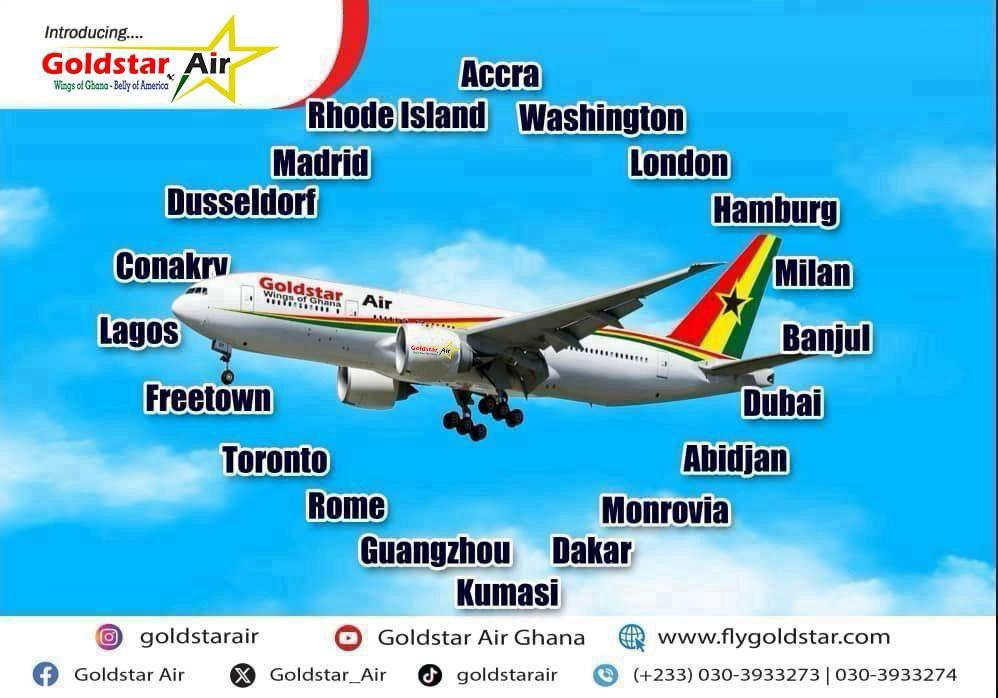
Goldstar Air, the wings of Ghana and belly of America is ambitious in providing both scheduled and non-scheduled passenger and cargo air services. Initial operations will connect Ghana to North America, Europe, Asia, the Middle East, and Africa. The airline has chosen Washington, Rhode Island, London, Dubai, Guangzhou, Toronto, Milan, Hamburg, Madrid, Rome, Düsseldorf, Lagos, Freetown, Banjul, Conakry, Dakar, Monrovia, and Abidjan as major originating cities for its initial routes from Ghana. Direct non-stop services will be deployed where necessary.
#Flygoldstar
#WingsOfGhana
#BellyOfAmerica
#OverTwoMillionJobOpportunities